


Kingdom Contours
What's the ecclesial minimum — and what actually multiplies?
How do we attract more people into our weekend worship services and church building programs?
If you remove any of the six elements, you create imbalance that restricts a disciple-making movement.
Overview
Empowering Everyday Disciples With Movemental DNA
What is the church, really, when you strip away the million-dollar budgets, the multi-camera broadcast systems, the professional worship bands, and the complex institutional machinery? What is the ecclesial minimum required for the body of Christ to gather faithfully, live in deep community, and multiply disciples across cities and nations?
In Kingdom Contours: Empowering Everyday People With the Tools to Shape Kingdom Movements (2020), we sought to answer these pressing questions for the post-Christendom Western world. Having spent decades planting decentralized churches in Richmond, Virginia, coaching church planters through Forge America, and now fostering microchurch collectives in Denver, Colorado, we observed a tragic reality: the modern Western church model has largely transformed everyday followers of Jesus into passive consumers, spectators in an auditorium who outsource the work of the ministry to a small cadre of credentialed professionals.
Yet when we study the New Testament and the explosive, viral multiplication of Jesus movements throughout history—from the house churches of the Roman empire to the underground church in China and Celtic monasticism—we discover an entirely different architecture. Movement does not belong to experts; it belongs to ordinary people who carry the essential, reproducible DNA of the kingdom.
Grounded in mDNA and the Trinitarian Load-Bearing Wall
In developing the six foundational paradigms of Kingdom Contours, we stand openly and gratefully on the shoulders of Alan Hirsch and his seminal formulation of mDNA (The Forgotten Ways). As we openly acknowledge in the text: "We take no credit for the outline or some of the terminology." What we have done is field-test, codify, and adapt these paradigms so that ordinary fathers, mothers, baristas, software engineers, and community organizers can embody them without needing a seminary degree.
Crucially, in Kingdom Contours, Jesus-Centered & Trinitarian communion sits in the hero position—what Scott Brennan of the Community of Aidan and Hilda identifies as the foundational load-bearing wall. Movements are not launched by adopting hip organic language or flattening church governance into small home groups. Organic structure without the living presence of the Triune God is just another empty organizational shell. When disciples dwell deeply in the mutual love of Father, Son, and Holy Spirit, disciple-making, missional-incarnational presence, movemental wisdom, organic structures, and deep community become the natural fruit of their life together.
Non-Dogmatic Ecclesiology: "Not the Only Way"
One of the greatest dangers facing missional pioneers is what we call microchurch dogmatism—the sectarian arrogance that looks down on traditional, congregational, or liturgical churches and declares, "Our way is the only biblical way to do church." We vehemently reject this spirit.
Returning to our integrating metaphor of Pando: the aspen forest contains groves of every size and age. God loves the parish church, the historic cathedral, and the suburban congregation just as He loves the living room microchurch. We do not promote decentralized microchurches because we believe traditional churches are invalid; we champion them because they provide an accessible, low-barrier, highly reproducible vehicle for everyday disciples to step out of the audience and into the harvest field.
The usual question:
How do we attract more people into our weekend worship services and church building programs?
The better question:
What's the ecclesial minimum — and what actually multiplies?
The Six Foundational Paradigms (mDNA Architecture)
In Kingdom Contours, we present the Six Foundational Paradigms of church movements, grounded directly in Alan Hirsch’s apostolic mDNA (The Forgotten Ways) and adapted for everyday practitioners:
Jesus-Centered & Trinitarian
Disciple-Making
Missional-Incarnational
Movemental Wisdom
Organic Structures
Deep Community
The Biblical Mandate
Lineage of Movemental Ecclesiology
Kingdom Contours stands within the lineage of the global missional movement that began gaining traction in the late twentieth and early twenty-first centuries. Following the groundbreaking missiological work of Lesslie Newbigin, David Bosch, and Roland Allen, church leaders began recognizing that the Western church was entering a post-Christendom era requiring apostolic renewal.
In 2006, Alan Hirsch published The Forgotten Ways, introducing the world to mDNA (movement DNA)—the six catalytic elements found in every spontaneous Jesus movement from the early church through the Chinese house church movement. In 2020, Jeremy and Monica Chambers published Kingdom Contours: Empowering Everyday People With the Tools to Shape Kingdom Movements.
Drawing from their field work planting Arise RVA and coaching networks through Forge America, Jeremy and Monica translated Hirsch’s seminal mDNA categories into an inductive, field-ready handbook for everyday disciples. With Scott Brennan contributing on the Trinitarian foundation and Alan Hirsch providing the afterword, Kingdom Contours became a foundational text for microchurch movements across North America and beyond.
Historical Context & Movement Lineage
Lineage of Movemental Ecclesiology
Kingdom Contours stands within the lineage of the global missional movement that began gaining traction in the late twentieth and early twenty-first centuries. Following the groundbreaking missiological work of Lesslie Newbigin, David Bosch, and Roland Allen, church leaders began recognizing that the Western church was entering a post-Christendom era requiring apostolic renewal.
In 2006, Alan Hirsch published The Forgotten Ways, introducing the world to mDNA (movement DNA)—the six catalytic elements found in every spontaneous Jesus movement from the early church through the Chinese house church movement. In 2020, Jeremy and Monica Chambers published Kingdom Contours: Empowering Everyday People With the Tools to Shape Kingdom Movements.
Drawing from their field work planting Arise RVA and coaching networks through Forge America, Jeremy and Monica translated Hirsch’s seminal mDNA categories into an inductive, field-ready handbook for everyday disciples. With Scott Brennan contributing on the Trinitarian foundation and Alan Hirsch providing the afterword, Kingdom Contours became a foundational text for microchurch movements across North America and beyond.
Stories from practice
The Barista and the Coffee Shop Microchurch
2016–2018 — The Barista and the Coffee Shop Microchurch
A barista gathered a simple weekly table around coffee and scripture, leading co-workers to Christ and multiplying into a second microchurch.
Pathway connection: Proves that ordinary disciples without institutional funding can plant multiplying microchurches using the simple In/Out/Up rhythm.
Releasing APEST in a Suburban Neighborhood
2020 — Releasing APEST in a Suburban Neighborhood
A microchurch unlocked shared leadership by distributing apostolic, prophetic, and evangelistic functions across ordinary community members.
Pathway connection: Shows how activating the fivefold intelligences (APEST) eliminates single-leader burnout and releases full-body ministry.
Kingdom Contours Microchurch Accelerator
Resources for the journey
Articles for this theme
book(link)
Kingdom Contours: Empowering Everyday People With the Tools to Shape Kingdom Movements
By Jeremy & Monica Chambers (2020 revised edition). Field-tested guide to the Six Foundational Paradigms, with afterword by Alan Hirsch.
book(link)
The Forgotten Ways: Reactivating Apostolic Genius
By Alan Hirsch (Brazos Press). The seminal work on mDNA that serves as the theoretical framework for Kingdom Contours.
book(link)
The Permanent Revolution: Apostolic Imagination and Practice for the 21st Century Church
By Alan Hirsch & Tim Catchim (Jossey-Bass). Groundwork on Ephesians 4 APEST equipping architecture.
podcast(link)
Forge America Missional Podcast: Kingdom Movements Around Dinner Tables
Jeremy Chambers sharing insights on decentralized church planting and releasing the priesthood of believers.
The Movemental Ecclesiology Mentor
The AI Lab mentor for Kingdom Contours guides practitioners, church planters, and ordinary disciples in applying reproducible movement DNA (mDNA) to their local context. Grounded in Alan Hirsch’s apostolic frameworks and tested through decentralized microchurch networks, this mentor assists you in designing simple In/Out/Up gathering structures, activating APEST fivefold equipping, and avoiding the trap of microchurch sectarian elitism.
- Try: “How do I guide our small group to transition from a social Bible study into an In/Out/Up microchurch?”
- Try: “Help me identify the fivefold (APEST) giftings in our ordinary team members and design equipping roles for them.”
- Try: “How do we keep our microchurch firmly anchored in Trinitarian prayer so we don’t become just another social club?”
- Try: “How can we build healthy, honor-filled relationships with traditional churches in our city rather than being sectarian?”
Questions people ask
Distortions Named in Our Own Voice
As church leaders and planters seek fresh movemental models, subtle ecclesial distortions can easily derail reproducible multiplication into narrow sectarian tribalism or sterile organizational machinery.
Microchurch Dogmatism ("It’s the Only Way")
Clergy Dependency & Spectator Passivity
Movement Divorced from Jesus
Pathway vocabulary
- Kingdom Contours
- The essential, reproducible shapes and patterns of the kingdom of God that empower ordinary disciples to embody the gospel and catalyze Jesus movements.
- mDNA (Movement DNA)
- The six catalytic ecclesial elements articulated by Alan Hirsch (The Forgotten Ways) and adapted in Kingdom Contours, with Jesus-Centered Trinitarian prayer as the hero foundation.
- Ecclesial Minimum
- The simplest reproducible expression of church life required for disciples to gather, worship, care for one another, and engage in outward mission without complex institutional overhead.
- In / Out / Up Rhythm
- The three-fold relational pattern of microchurch gatherings: mutual soul care (In), neighborhood mission and hospitality (Out), and Trinitarian prayer and scripture (Up).
- Multiplication Axiom (3, 2, 1)
- The reproducible discipleship pathway: discipling 3 emerging leaders, coaching 2 into ministry leadership, and seeing 1 multiply to a third generation.
About Jeremy & Monica Chambers
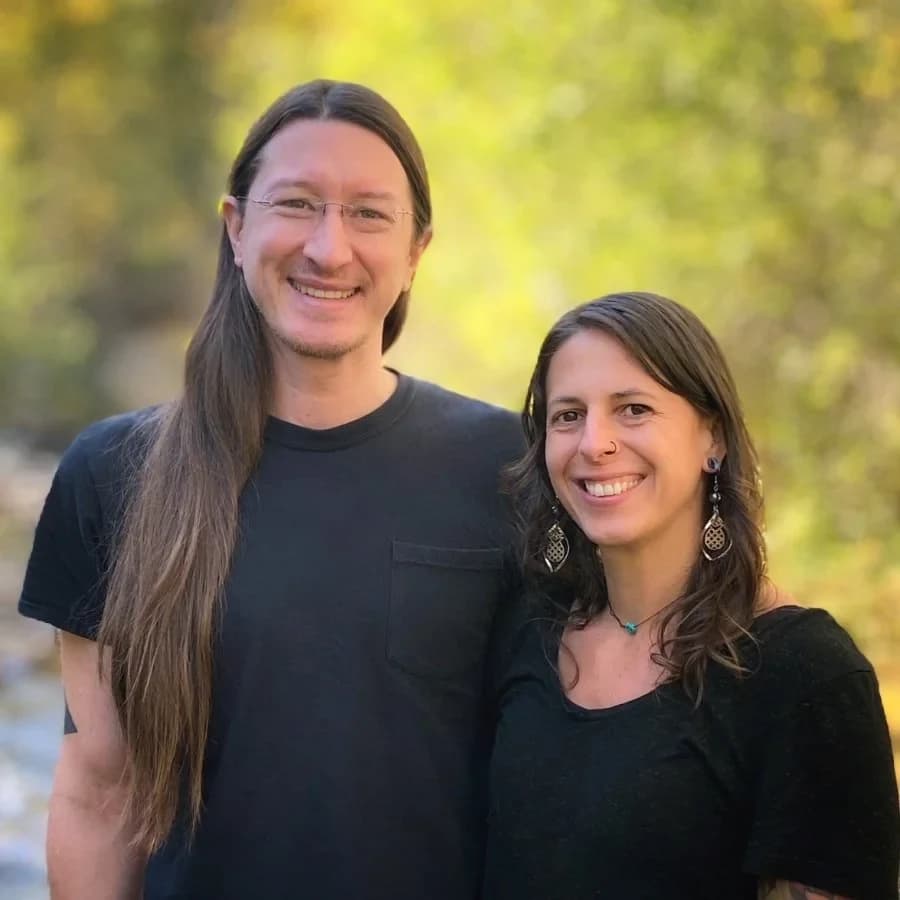
Jeremy "Jemo" Chambers is an American church planter, urban missionary, spiritual director, author, and trainer whose vocational life sits at the seam between contemplative spiritual formation and missional-movement practice. Born around 1986, he has said he began praying about a
Kingdom Contours